

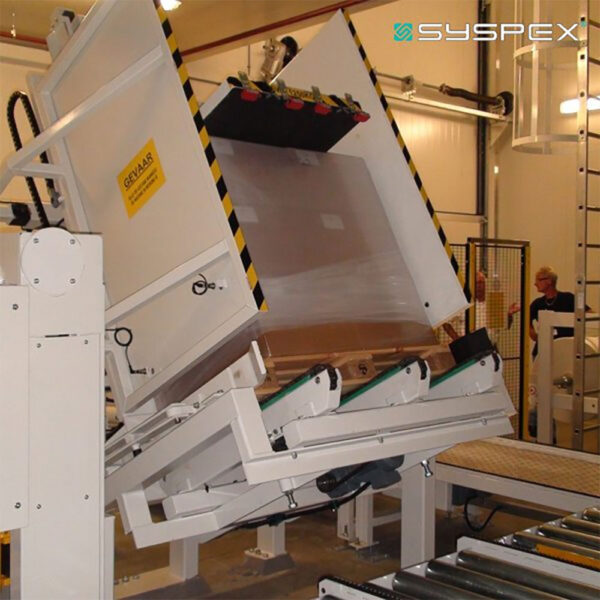
Versatile Load Transferring for Strict Hygienic Environments
Pharmaceutical, chemical, and food processing industries must maintain strict sanitary barriers to prevent cross-contamination. Our sourced range of equipment handles delicate, heavy, or unstable goods with extreme care during the transfer process. Whether your facility utilizes a stationary hydraulic pallet inverter that safely rotates loads up to 180° to slide a new base underneath, or a side-clamping lateral system, these machines allow operators to exchange dirty wooden shipping pallets for pristine, cleanroom-grade plastic or aluminum alternatives smoothly and damage-free.
Boosting Operational Safety and Eliminating Manual Restacking
Relying on manual labor to break down, lift, and restack full pallet loads of heavy boxes, drums, or bags is a major source of warehouse bottlenecks, operator fatigue, and product damage. As an end-to-end solutions provider, Syspex addresses these speed limitations by sourcing automated tipping and clamping systems. Transitioning to an industrial pallet inverter or changer allows a single operator to execute a complete pallet swap in less than a minute at the push of a button. This mechanical upgrade drastically lowers labor costs, protects workers from repetitive strain injuries, and keeps your high-volume distribution lines moving cleanly.
The SYSPEX Advantage in End-to-End Integration
- 30 Over Years of Industrial Experience With over three decades of work, we act as your trusted solutions provider. We deliver complete material handling consultation, workflow optimization, and load-stability planning.
- Consultative Engineering We work closely with your team to review your specific load weights, package types, and facility clearance heights, ensuring your sourced switching configuration integrates seamlessly into your production floor.
- Regional In-House Technical Expertise Our own technical engineer team is located in Singapore, Malaysia, and Indonesia. This means we can provide fast deployment, system testing, and preventative maintenance support to guarantee continuous uptime.
- Sustainability Commitment We source robust, low-emission hydraulic and electrical machinery engineered for maximum durability, helping your business lower its environmental footprint by extending the working lifecycle of your internal captive pallets.
Frequently Asked Questions
A pallet inverter physically rotates an entire loaded pallet up to 180 degrees, tilting it securely so the operator can easily slide the old pallet out from the top and insert a new one before rotating it back. A specialized pallet changer typically uses side-clamping plates to lift or stabilize the load laterally from the bottom up, allowing the pallet to be swapped out at ground level without rotating the product upside down.
Strict hygiene regulations forbid external wooden pallets from entering clean manufacturing or packaging cleanrooms because wood can harbor bacteria, dust, moisture, and pests. A pallet changer is used at the transition zone to quickly transfer raw materials from incoming wooden transport pallets onto sanitized plastic or metal captive pallets.
Yes. Sourced inverters are engineered with adjustable, pressure-controlled hydraulic clamping plates. Operators can easily program the system to apply the exact amount of side or top pressure needed to hold the load securely during rotation without crushing soft cardboard boxes, plastic jugs, or flexible bags.
These robust material handling systems are highly versatile. They can easily process a wide variety of heavy industrial loads, including stacked cartons, raw ingredient sacks, plastic drums, bulk liquids, unboxed machinery components, and fragile glass bottles weighing up to 2,000kg.
We offer both configurations depending on your warehouse layout. Stationary units are heavy-duty systems bolted directly to the facility floor for permanent, high-volume production lines. We can also source standalone or mobile floor-level systems that can be moved with a standard forklift to wherever a pallet swap is required.
The return on investment is achieved through massive labor hour reductions and a drastic decrease in workplace injury claims. By transforming a slow, dangerous 20-minute manual restacking chore into a fast, automated 60-second mechanical process, businesses double their processing capacity and eliminate product handling damage.